
Six or seven years ago, I started telling anyone who would listen that American education was entering a “fifth wave.” A lot of people thought I was crazy. A few were kind enough to nod.
British statistician George E. P. Box popularized the aphorism, "all models are wrong, some are useful.” The shorthand for my model goes like this:
The first wave was centered on fundamental issues of access: Brown, the 1975 law that became IDEA, Plyler.
The second wave focused on providing the wherewithal to make good on the promise of access: Title I, Pell, the adequacy lawsuits.
The third wave (standards and accountability), which spanned “A Nation at Risk” to ESSA, asked what we were getting for our money and how to level the playing field by instrumenting systems.
Partly out of political expediency and partly because of the perceived unworkability of accountability at scale, policy elites (and the philanthropic establishment) began to shift their focus toward college access and completion, which became the fourth wave. More on that here.
Along the way, we decided to treat college readiness and career readiness as though they were one and the same. But in the words of Ridgeline co-founder Pat O’Donnell, it's time to stop treating "college as a career plan."
The fifth wave is about moving beyond proxies (whether tests or degrees) toward a more fundamental question of how and whether educational experiences (wherever, and however they occur) translate into economic mobility.

Of course, none of these waves are “over”—nor should they be. Plyler drew fresh challenges last year, the same year NAEP scores hit record lows. States are still rewriting funding formulas. But each new wave arrives just as the promise of the earlier ones start to fray.
Although the fifth wave shift has been building for some time, it has accelerated in recent years.
In 2021, JFF’s Big Blur made the case for treating grades 11 through 14 as one system with no wall between high school, college, and work. In 2024, Talent Disrupted, from the Burning Glass Institute and Strada, showed more than half of bachelor’s graduates starting out in jobs that don’t require the degree, and 45% still there a decade later. Workforce Pell was signed into law July 4, 2025. The same month, the Gates Foundation announced an ambitious goal of helping 10 million more learners earn “credentials of value“ by 2045.
When Gates picks a new North Star, everyone else checks their compass.
Earlier this month, TNTP (which has been focusing on fifth-wave concerns for years) announced the launch of a Mobility Center. To me, it was striking that an organization that built its name on teacher quality and classroom rigor, was also building for a world where, in the words of TNTP’s Tequilla Brownie, “the proxies are breaking, and they are breaking even for the students who did everything we asked of them.”
TNTP has tied the Center to a public target, too: 50 million young people on a measurable path to economic mobility by 2035. The Center’s first order of business is to develop measures that show whether a young person is on track while there is still time to act. Rest assured, Brownie is embracing this work with optimism: “Young people are capable of far more than our systems are built to recognize, and the economy is full of opportunities they could reach.”
Of course, the fifth wave also comes with new challenges. Two of the biggest were well summarized in a powerful article by Gates Foundation's Cheryl Hyman, published last month:
“At the individual level, I want people to have better information when they make consequential choices. How do we build enough infrastructure that learners have the agency to make genuinely different decisions?
At the market level, I want us to understand where value is being created and where we are allowing it to disappear. How do we unlock enough transparency and comparability to force real competitiveness into the educational landscape?”
Neither question has an easy answer, and both are just a piece of the fifth wave puzzle. Although previous waves suggest we’ll be working on them for decades, they’re certainly among the right sort of questions, and it's encouraging to see more and more people asking them.
In this week’s edition, we round up the “Top 10 Articles of the Week” and take a closer look at:
Spanberger Pulls Virginia Out of Federal Scholarship Tax Credit Program
Higher Education is a Consolidating Market for EdTech
Deep Dive: 2026 Education and Funding Ballot Measures
New Guide Challenges Colleges to Tie Basic Needs Support With Completion
Common App Signals Rebound in International Applicants After Enrollment Drop
Top 10 Articles of the Week from W/A’s What We’re Reading Newsletter
AI Raises Big Questions for the Future of Teacher Education [Education Week, subscription model]
Don’t Bet on the Return of DEI [Chronicle of Higher Education, subscription model]
Lemnis Commits $20 Million to AERDF Neuroscience Initiative [Inside Philanthropy, subscription model]
‘Beyond the College Walls’: Urging community colleges to think bigger [Community College Daily]
The hidden data colleges need to improve graduation rates [University Business]
The Job Skill Employers Need Most May Be The Ability To Disagree [Forbes, subscription model]
Why Scheduling Is Essential for Transfer Student Success [Inside Higher Ed, subscription model]

Spanberger Pulls Virginia Out of Federal Scholarship Tax Credit Program
Last Friday, Virginia Gov. Abigail Spanberger announced she won’t complete the state’s enrollment in the federal scholarship tax credit (FSTC) for 2027, reversing former Gov. Glenn Youngkin’s decision to opt in. Treasury says she can’t do that.
Treasury Secretary Scott Bessent posted on X that Virginia has already elected to participate and that the governor is required under federal law to complete the administrative process, which means submitting the state’s list of scholarship granting organizations by February 15.
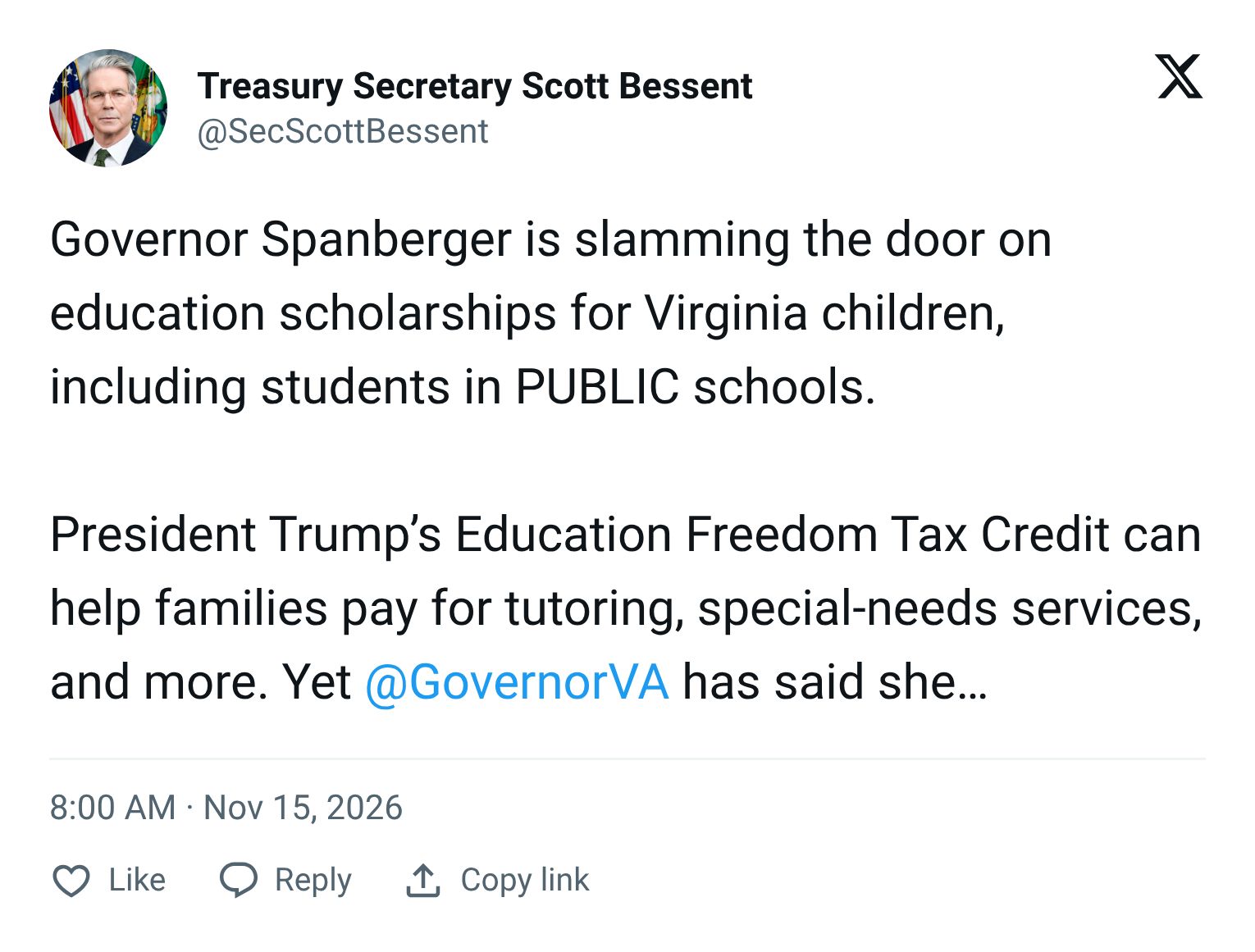
While Virginia’s situation with respect to the FSTC is unique, since Gov. Spanberger has been in office since January, it’s an early look at how Democratic governors may handle school choice programs they inherit.
Most of the governors elected this month won’t take office until after the January 1 deadline, so their FSTC decisions will affect participation in 2028. States can start opting in for 2028 on January 2, the day after taxpayers can begin making donations that qualify for the credit.
Comments on Treasury’s proposed regulations are due December 1, and Treasury’s guidance on the FSTC’s incorporation of the Coverdell regulations is still forthcoming, so more is coming soon.
Questions? Get in touch with our team.

Higher education is a consolidating market. According to an analysis of financial transactions from the last three years by Matt Tower, W/A VP and editor of The EdSheet, acquisitions now outpace venture investment in higher education technology, venture funding is down by about half of 2024 levels, and recent federal policy changes are bound to shake things up even more.
Matt breaks down what these market conditions mean for edtech investors and founders. Share your questions, thoughts, and predictions with Matt.
Deep Dive: 2026 Education and Funding Ballot Measures

In our pre-election look at education ballot measures, we highlighted the state and local referendums most likely to reshape school budgets. Voters have now weighed in.
W/A Research tracked 82 education-related ballot measures in our elections hub. Across the country, voters turned down spending mandates that came with no new money, and kept or added taxes on high earners that fund schools. Two of the most contentious questions, in Arizona and Colorado, came down to a few percentage points. At the local level, voters approved many of the school bonds and levies.
Arizona: Spending Mandate Rejected
Arizona's Proposition 320, which would have required large districts to spend at least 60% of operating budgets on "direct instruction," failed. Unofficial results show 51.9% voting no and 48.1% voting yes.
Taxes on High Earners: Schools Come Out Ahead
In all three states where voters weighed in on taxing top earners, the outcome protected or expanded education revenue.
California Prop 3 passed. The high-income tax rates set to expire in 2031 are now permanent, preserving an estimated $5 billion to $15 billion per year, roughly 40% of it for schools and community colleges to stave off a potential funding cliff.
Washington Initiative 645 rejected the repeal. The Associated Press had called the race for "No," 57.6% to 42.4%. The new 9.9% "millionaires' tax" stays on track, along with the roughly $3.5 billion a year in projected revenue, a portion of it for K-12, school meals, and early learning.
Colorado Initiative 195 (Amendment 87 on the ballot) passed narrowly, and the competing Proposition 136 failed. Colorado will replace its flat income tax with graduated rates and create a fund for education, health care, and early childhood. The 4.4% cap that would have blocked it lost by about five points. Voters also approved Proposition NN, which raises the state's revenue cap so Colorado can keep about $330 million more in the first budget year and about $521 million the year after, with at least half going to K-12.
In a “Blue Tsunami,” Democrats flipped 12 state legislatures—and that energy carried down the ballot. In Colorado, voters turned down statewide K-12 tax increases repeatedly, including Proposition 103 in 2011 and Amendment 66 in 2013, and rejected another graduated-tax proposal in 2018 (Amendment 73). This year, Amendment 87 narrowly passed, and analysts credited a Democratic-leaning turnout wave and voters' concern about wealth inequality with getting it over the line.
These votes matter beyond their own states. Lawmakers and advocates elsewhere who are weighing high-earner taxes for schools now have three recent examples to point to, at a moment when Democratic enthusiasm is high and support for asking top earners to pay more is growing. That support has limits: In the same election, California voters rejected a one-time tax on billionaires' wealth. Measures tied directly to schools fared better than broader wealth taxes.
Local Measures: Mixed Results
Many measures for local bonds, mill levies, and tax renewals that provide funding for school operations and facilities were approved. (See details by state and ballot measure here.)
California: San Diego Measure M authorized up to $3.5 billion for school facilities.
Colorado: Colorado Springs District 11 approved a $775 million bond for school facilities; Denver Public Schools passed a $44 million mill levy override. Jefferson County’s proposed facility measure failed, and the $73 million mill levy override for teacher pay and educational programs is headed to a mandatory recount.
Florida: Broward, Hillsborough, and Miami-Dade county public schools renewed multi-million-dollar school funding referendums.
Georgia: Fulton County Schools, DeKalb County Schools, and portions of Atlanta Public Schools will benefit from 1% sales tax, expected to generate more than $925 million by 2032.
Indiana: Indianapolis Public Schools passed a $95 million annual operating referendum.
Kansas: Wichita Public Schools approved a $615 million bond package.
Michigan: Dearborn, Birmingham, and Farmington passed bonds totaling about $1.92 billion.
Minnesota: Robbinsdale Area Schools approved $360 million in projects.
Missouri: St. Louis-area districts passed 11 of 12 school measures, including a $150 million bond in Francis Howell and up to $90 million in Fort Zumwalt; only Hillsboro R-3's operating levy increase failed.
New Mexico (statewide): Voters authorized up to $19.3 million in general obligation bonds for academic, public school, tribal, and public library resources, funded by a statewide property tax.
Local approvals were not universal. In Colorado, the same voters who approved higher taxes on top earners turned down a number of local tax increases amid cost-of-living worries. This includes Douglas County School District's $54 million mill levy override, which would have paid for a 4% raise for teachers and staff. Voters appear to distinguish between asking the wealthiest households to contribute more and raising costs on families already stretched by higher prices.
What this means for school districts will play out over the next several budget cycles, amid continued budget constraints related to rising costs and declining enrollment.
Quick Takes
New Guide Challenges Colleges to Tie Basic Needs Support With Completion
Nearly three in four college students experience some form of basic needs insecurity, yet 65% are unaware of campus resources that could help. A new guide from Complete College America institutions to rethink how they support students struggling with food insecurity, housing instability, child care, transportation and other essential needs.
The guide introduces a three-phase framework with 10 metrics to help institutions assess student needs, identify gaps in support, and connect services to retention and completion outcomes. With limited resources and growing student needs, colleges must prioritize interventions that deliver measurable results and make basic needs support central to student success.
Common App Signals Rebound in International Applicants After Enrollment Drop
This week, the Common App shared an early look at first-year college applicant trends for the 2026-27 admissions cycle. The data, up to date as of November 1, show a 9% increase in international student applicants, compared to a 9% YOY decrease in applicants at this time in the 2025-26 cycle. These data come just days after the Institute for International Education reported that international student enrollment at U.S. colleges declined by 9% this fall, citing rising tuition costs and visa restrictions. While it remains to be seen whether international student applicant rates will hold (and, more importantly, translate into enrollment gains), these data paint a hopeful picture for the higher ed institutions that rely on revenue from foreign students to balance their budgets. [Bloomberg, subscription model; WBUR]

Check out W/A Jobs, which features 3,762 career opportunities from 327 organizations across the education industry. Hiring? For $250/month or $1,000/year, organizations can post an unlimited number of jobs with no per-job fees.
People on the Move
The Louisiana State Board of Elementary and Secondary Education appointed Jenna Chiasson to serve as the state’s next superintendent of education, effective December 1. Chiasson succeeds Cade Brumley, who was recently named president of the University of Louisiana System. [WBRZ; Louisiana Illuminator]
The State Higher Education Executive Officers Association (SHEEO) welcomed Theresa Thompson as a senior policy analyst. In this role, Thompson will support SHEEO’s state postsecondary data initiative. Thompson previously served as senior research associate in policy analytics at the State Council of Higher Education for Virginia (SCHEV).
Accelerate announced Jennifer Bronson as its next chief program officer. Bronson, who has served as Accelerate’s managing director of learning programs since 2023, was formerly executive director of Chattanooga 2.0 and chief of staff of the Hamilton County Department of Education.
Apprenticeships for America appointed Matthew Muench as its next CEO, effective January 2027. Muench—who previously served as head of jobs and skills at JPMorganChase and director of workforce innovation for the city of Chicago— succeeds John Colborn, who has led the organization since 2023.
Guadalupe Guerrero was selected as Belmont-Redwood Shores School District’s (CA) next superintendent. Guerrero has more than three decades of experience in public education, and was previously superintendent of Portland Public Schools and deputy superintendent of San Francisco Unified School District. Guerrero was most recently the CEO of the Partnership for Los Angeles Schools.
This week, the Council of Chief State School Officers announced its 2026-27 Board of Directors. Connecticut Commissioner Charlene Russell-Tucker was named president; West Virginia Superintendent Michele Blatt as president-elect; and Washington Superintendent Chris Reykdal as past president. Colorado Commissioner Susana Córdova and Arkansas Secretary Jacob Oliva will serve new terms as directors, and Indiana Secretary Katie Jenner will serve a second term as a director. [CT News Junkie]
Jobs That Caught Our Eye This Week
ETS is hiring a Washington, D.C.-based Research Scientist to lead and contribute to the organization’s research agenda, focused on schooling, human capital development, and economic mobility, among other topics.
Pluralsight is hiring a Westlake, TX-based Director of Talent Acquisition to lead the organization’s global talent acquisition team, and modernize recruitment processes.
ACT is hiring an Iowa City, IA-based Senior Proposal Specialist to monitor for upcoming RFPs, strengthen proposals, and own and improve competitive intelligence processes.
Campus is hiring a New York City-based Senior Affairs Program Manager to provide services and build programs that connect students to meaningful work, mentorship, and professional growth opportunities.
Pearson is hiring a Principal of Enterprise and Institutional Strategy to lead strategic growth initiatives and improve the organization’s competitive position.
Upcoming Events and Convenings
Complete College America: CCA Annual Convening, December 1-3, San Diego, CA.
ExcelinEd: National Summit on Education, December 2-4, Washington, D.C.
ACTE: CareerTech VISION 2026, December 2-5, New Orleans, LA.
Branching Minds: MTSS Summit 2026: Connected Systems, Confident Practice, December 3, Virtual.
New England Board of Higher Education: Higher Education at America’s 250th Anniversary: Examining the Truths We Hold to be Self Evident, December 3-4, Boston, MA.
NAEYC: NAEYC Annual Conference, December 5-8, Washington, D.C.
Chalkbeat: Have American Educators Been Sold a Story on How to Teach?, December 8, Virtual.
Unlimited Instruction: Budget with Confidence: Rethinking How Districts Pay for Staffing, December 8, Virtual.
AAC&U: Higher Education at 250: Purpose, Trust, and Transformation, January 20-22, 2027, Seattle, WA.
Achieving The Dream: DREAM 2027, February 2-5, 2027, Columbus, OH.
NASSP: National Principals Conference 2027, February 6-9, 2027, Tampa, FL.
American Council on Education: ACE Experience 2027, March 2-6, 2027, Washington, D.C.
SXSW: SXSW EDU 2027, March 13-16, 2027, Austin, TX.
ASU+GSV: ASU+GSV Summit 2027, April 4-7, 2027, San Diego, CA.
AACRAO: Annual Meeting 2027, April 4-7, 2027, Long Beach, CA.
UPCEA: Annual Conference 2027, April 13-15, Anaheim, CA.
